Showing posts with label Automation. Show all posts

Monday, April 18, 2016

Conveyor Sortation Systems: Manufacturing & Automation Technology

conveyor-based sortation systems
Technology has played a pivotal role in industrial applications and the advancement of greater levels of efficiency and throughput. In specific sectors like manufacturing, logistics, warehousing and distribution, conveyor-based sortation systems have been a major proponent of this progression. In fact, the conveyor sortation system is among the leading systems used in manufacturing and distribution to this day.

How Conveyor Sortation Systems Work

Conveyor sortation systems are developed to deliver reliable services to the production and manufacturing industries. They are split into several sections that work together to offer an efficient and dependable production. A conveyor sortation system comes in several types, including the loop sortation and the linear sortation.

In-Line Sorters/Linear Sortation Systems
Conveyor Sortation Systems

In-line sorters, or linear sortation systems, can sort the parcels and other loads in a straight line. These more convention sortation systems for conveyors will induct a certain product at a particular end, then move it in the same line with other products. The parcels will then be split or diverted to one side or both of them. The splitting of the parcel will depend on the category, which can be automated from the control unit.

Circle Sorters/Loop Sortation System

Circle sorters, also known as loop sortation systems, can be set to operate with a small radius size, which helps to maximize the space needed. Circle conveyor sorters entail a set of cells that are combined on a single track. With these systems, the product is introduced into the cells automatically or manually. They will be introduced from anywhere along the conveyor sortation system.

The identification of the products is made through scanning, or it can be linked to an individual induction station. This system is used by many distribution companies. When associated inventory and the cells reach the point of diversion, the mechanism of diversion is activated. This will then send the stock to the designated location.

These two sorter conveyor systems are the common ones used in many manufacturing and distribution companies. With the linear sortation system, they can be driven by a belt or a chain, but they will have diverted mechanisms that are incorporated or mounted to the sortation system.

Benefits of Conveyor Sortation Systems
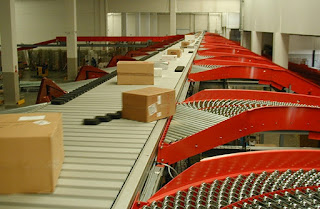
Circle Sorter Machines

  • They protect the quality of the product. The products are handled by an automated sortation system, which is gentle on them.
  • They maximize the workspace. Such systems like the looping sortation systems can have an adjusted radius curve that helps to maximize the size.
  • They are versatile. The system can handle different types of product that range in size, shape, and category. This means that they will sort even items with irregular shapes or one with extra weight.
  • Minimizes the maintenance. The conveyor sortation system entails less moving parts, and there is a single driver for each sorter.
  • The sortation can be automated. Instead of manually sorting out parcels that belong to a certain category, the sortation system can be automated to sort the items mechanically.
The conveyor sortation systems have proven to be useful in the production and manufacturing industry. With these automation solutions, warehousing, distributing, and 3PL-logistics companies have made their work easier.

The production level has also increased, meaning that the system is a great asset in the industry. The maintenance and workload are reduced as well. With this, the delivery of the products is improved, and there is a limited margin for error. Since the items are handled gently with the sophisticated system, it implies that they will be less wastage and more precision in production.

Friday, March 11, 2016

5 Cutting-Edge Technologies Revolutionizing Warehouse Automation

As the world embraces technological innovation in many areas of life and commerce, competitive businesses are consistently searching for ways to automate their primary operations for greater efficient. For companies in logistics, warehousing, and distribution, technology is generally the break point or make point. Warehouse businesses in particular use new technology in order to remain competitive in their sector.
Warehouse Automation Technology

Businesses and organizations have accepted technology by automating many of their operations. Automation is a benefit to any business since it leaves little room for mistake, particularly along an assembly area. The business may also meet its set targets easily when it comes to production because of automation. This is unavoidable the approach to take for many of the businesses.

We are now one business that helps other companies install automated equipment into the system. You will discover quite a lot of automated machines available for logistics warehouses as well as distribution centers. A number of them include:

Sortation Systems

Sortation systems are essential warehouse automation investments for big parcels, mailers, cases and other products that go through a sorting process. Functions for sortation sorting machine systems consist of zone routing for pick and then pass application, sort-to-order, shipping sortation and carrier, reject systems and a lot more.

The following are a few examples of typical conveyor sortation items that can be found:
  • Overhead sorters: suitable for small items, flats, parcels, and cases. Common for media applications and books.
  • Pop up Sortation: A 90 degrees systems that operate in-line with ZPA roller conveyor for case and parcel sortation.
  • Pushers as well as diverts: they are for parcel sortation, handling exception, and other apps.
  • Merge conveyors: needed when products have to be consolidated for shipment.
  • High-speed systems for sortation: like shoe sorters.

Picking Systems

This picking systems order is determined by businesses based on some common factors which include: Some of them include: attribute of the item being handled, picks per order, quantity per pick, value added processing like private labeling and a lot more. A few of the available picking systems include:
  • Picking systems design
  • Order picking software
  • Warehouse robotic solutions
  • Dispensing systems

In-motion Cubing & Dimensioning Systems

In-motion cubing and dimensioning systems are utilized to automatically capture dimensions of packages, bags, boxes, and even non-cuboidal or irregular shapes. The dimensioning process is specifically vital for carrier compliance as well as legal for trade apps. Many FedEx and UPS services and most international carriers need dimensional weight calculations on some kinds of shipments. Parcels which measure or calculate over limitations set as a result of carrier's cost more to ship because of dimensional weight factors.

Dimension cubing systems can process as much as 80 parcels per minute based on the carton dimensions. This technology offers some of the advanced dimensioners and cubers used to determine parcel and package dimensions for distribution and shipping. In-motion cubing and dimensioning systems, also known as cubers and dimensioners provide one of the industry's advanced in-motion dimensioning systems for package which is an integral section of the turnkey manifest lines.

Any kind of warehouse distribution center trying to automate its process can easily sure get many items that can be useful along the way. There are a number of machines, warehouse software and automated systems that are great investments for all types of distribution-based businesses.